
Colbert County Court Calendars Explained
The Circuit Clerk keeps settings for Colbert County Circuit and District Court cases. Three public labels do most of the work. They are "Court Setting Dates," "docket," and "Case Action Summary." A Case Action Summary preserves the whole sequence, including dates that have passed or moved. The official docket-list route works differently. It asks for a setting date. It also takes an optional last name. Each tool answers a different question.
The county posts no free daily-calendar PDF. There is no judge-specific coordinator directory, and no public Zoom calendar. That leaves the online setting form as the narrow calendar route. The form itself warns that some cases may not appear. When the date truly matters, the assigned court and clerk remain the source for confirmation.
Municipal dates do not form one countywide list. Muscle Shoals usually holds court Thursday at 1:00 p.m. Sheffield lists Wednesday at 1:30 p.m., and Tuscumbia lists Wednesday at 4:00 p.m. Littleville and Cherokee publish no session times. Contact each municipal clerk for its own city case.
Colbert County Court Dates by Docket
The official Colbert docket-list search is the quickest route when the hearing date is known. It also works when a short window needs checking. The form offers five rolling date choices. Select Setting Date. Add a surname only when it helps narrow the list. Leave Last Name blank and the form returns the entire docket for that setting date.
| Field | Required | How it works |
|---|---|---|
| Setting Date | Yes | Select the court date to search. |
| Last Name | No | Use it to narrow results, or leave blank for the full returned docket. |
| County | Fixed route | Verify that the page displays Colbert before using the result. |
| Search | Yes | Runs the setting-list request. |
The official setting form shown here makes the date and optional-surname split clear.
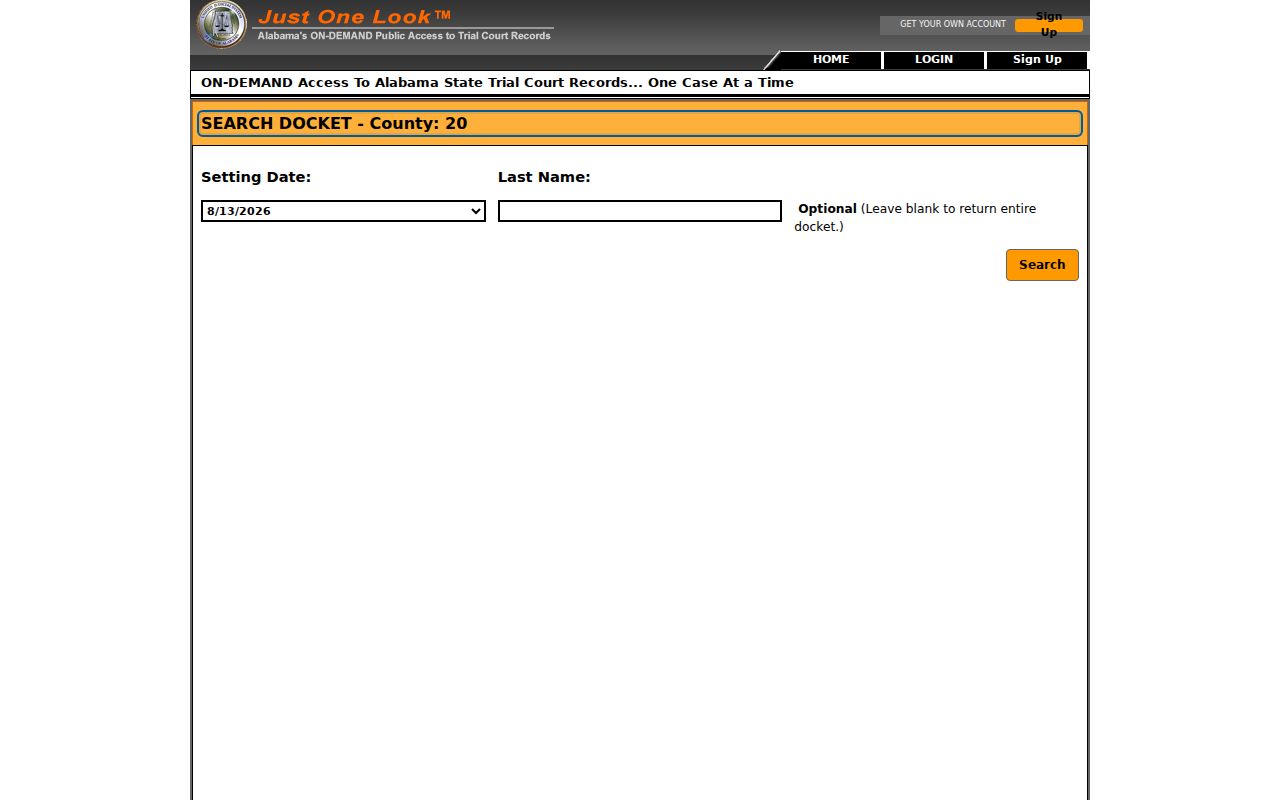
This view is a calendar lookup. It is not a complete case search, and it does not promise that every setting appears.
Finding Your Court Date
Start with the case number and party surname. Add the court division and any date already on a notice. A Circuit or District case belongs with the Circuit Clerk. A municipal case belongs with that city's clerk. Probate matters go to the Probate Office. Asking the wrong office can return a blank result even when a setting exists.
- Use the Colbert docket-list form for a date-based search. Select the setting date and add a surname only if needed.
- For a known case, use paid Alacourt ACCESS and inspect Court Setting Dates plus later Case Action Summary entries.
- Call the Circuit Clerk at 256-386-8511 with the case number, division, and date shown. Ask whether the setting changed.
- Visit the clerk at 201 North Main Street in Tuscumbia during posted weekday hours to inspect the file or available posted list. Confirm before travel because the official sources do not state how far ahead lists are posted.
- Registered Alabama attorneys may use AlaNotice for weekly notices, but a party should also check counsel and the official clerk file.
- For municipal or probate dates, contact that separate court rather than assume the county trial-court search contains the setting.
A complete Colbert County case lookup can supply the context behind one listed date. Never rely on a former setting when a later entry shows a reset, continuance, cancellation, or final order.
Two Colbert County Court Date Searches
The free date list and the paid case detail are easy to confuse. The date list searches one setting date. Narrow it by last name if you wish. It shows who or what is set in a short window. Paid Alacourt ACCESS works the other way. It searches by name or exact case number. It can return a broader case history, including court settings, actions, rulings, parties, financial fields, and available images.
| Route | Best question | Main limit |
|---|---|---|
| Colbert docket list | What is set on this date? | Narrow setting list; some cases may be absent |
| Alacourt ACCESS detail | What is the newest setting in this case? | Paid search and not a live certified record |
| Circuit Clerk | Has this date changed? | Requires the correct case and division details |
The paid result is still a snapshot. No public update schedule, result limit, export feature, or maintenance timetable is posted. A courtroom order or clerk update can be newer than a screen.
How to Read a Court Setting
Match a setting line to the correct court, case, and latest chronological entry. The official product categories cover court or location. They also cover case number, party or style, setting date, and setting or action information. Columns cover courtroom, judge, attorney, time, and setting type. They appear only after the result flow is completed. Check those details in the actual report. Or ask the clerk.
| Date | The scheduled day. Compare it with later continuance or reset entries. |
|---|---|
| Time | The listed call or hearing time, if supplied. Confirm it with the court. |
| Courtroom | The room or court location, if displayed. Do not assume the courthouse alone identifies it. |
| Judge | The assigned or presiding judicial officer where the actual result shows one. |
| Setting Type | The event, such as arraignment, motion hearing, docket call, pretrial, trial, or sentencing. |
A setting is not necessarily a trial. Docket call may simply test case readiness, a motion hearing concerns a stated request, and a pretrial conference addresses issues before trial. Read the label before planning around the event.
Colbert County Court Dates and AlaNotice
AlaNotice sends notices of new or changed settings once each week. Only registered Alabama attorneys can use it. Registration requires an attorney code and identity data. It is not a public text or email reminder program. The service also states one limit. The clerk's physical file is the official record.
The official AlaNotice page spells out that narrow role in court-date tracking.
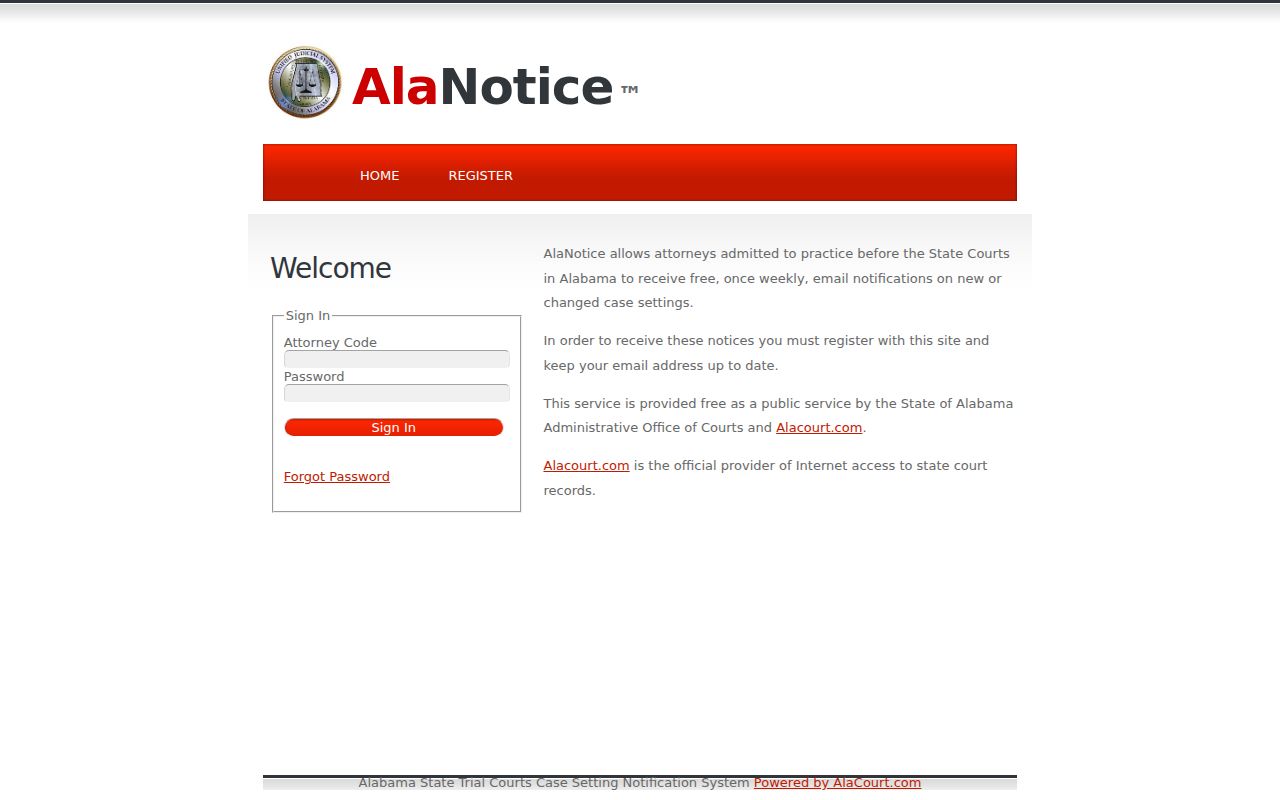
A weekly alert can help counsel track changes. Still, it does not replace a direct check of the newest docket entry and the Colbert County clerk's file.
Note: Colbert County Circuit and District Court offer no public reminder service, so parties should keep their own contact plan.
Continuances, Resets, and Cancellations
A continuance or reset pushes a matter to a new date. The old setting can linger on the Case Action Summary. That record works as a history. Scan the later entries for a continuance, reset, amended notice, cancellation, or disposition. The newest valid entry controls, but only after you confirm it.
A Colbert County docket may say a matter was "passed" or "continued." It did not go forward on the old date. That word does not mean the case was dismissed. A cancellation could stem from a settlement, a plea, a ruling, or some other case event. The calendar line alone rarely tells you which. Open the case history or ask the clerk.
The local civil information cautions that schedule changes happen, though rarely. No official Colbert page offers a universal continuance form. No coordinator list or promised lead time appears either. Filing a request does not move a setting by itself. Wait for a court order or a confirmed clerk entry.
Colbert County Court Date Terms
Setting labels on a Colbert County court docket describe the purpose of a date, never the final outcome. A single case can pass through several of these events, so read the label next to the division and the newest date.
- Preliminary hearing
- A District Court stage that tests probable cause before a felony proceeds to Circuit Court.
- Arraignment
- The stage when a criminal charge is addressed and a plea is entered.
- Docket call
- A calendar event where the court checks cases for readiness or other action.
- Motion hearing
- A setting for the judge to hear a specific request in the case.
- Review hearing
- A date when the court checks compliance with an earlier order or program.
A jury-trial setting can slide if another matter is reached first. A sentencing setting follows a conviction or a plea. Do not expand these labels with a guessed local code, since Colbert publishes no official abbreviation sheet.
Conflicting Colbert County Court Dates
Two sources showing different dates is a real hazard, and the convenient date is not always the right one. Compare timestamps and chronological order first. Check whether the older date is followed by a reset, amended notice, or disposition. Also confirm the case number and court division, since two matters with similar names may be entirely distinct.
Then call the correct clerk. For Colbert Circuit and District Court, dial 256-386-8511. Give the case number, the division, both dates, and where each date appeared. If you have counsel, contact that office too. A municipal matter belongs with that city's court clerk. The Circuit Clerk can explain state-court routing. It does not hold the municipal file. Account holders can also reach state court records through the Alacourt.com subscription login, which serves as official access.
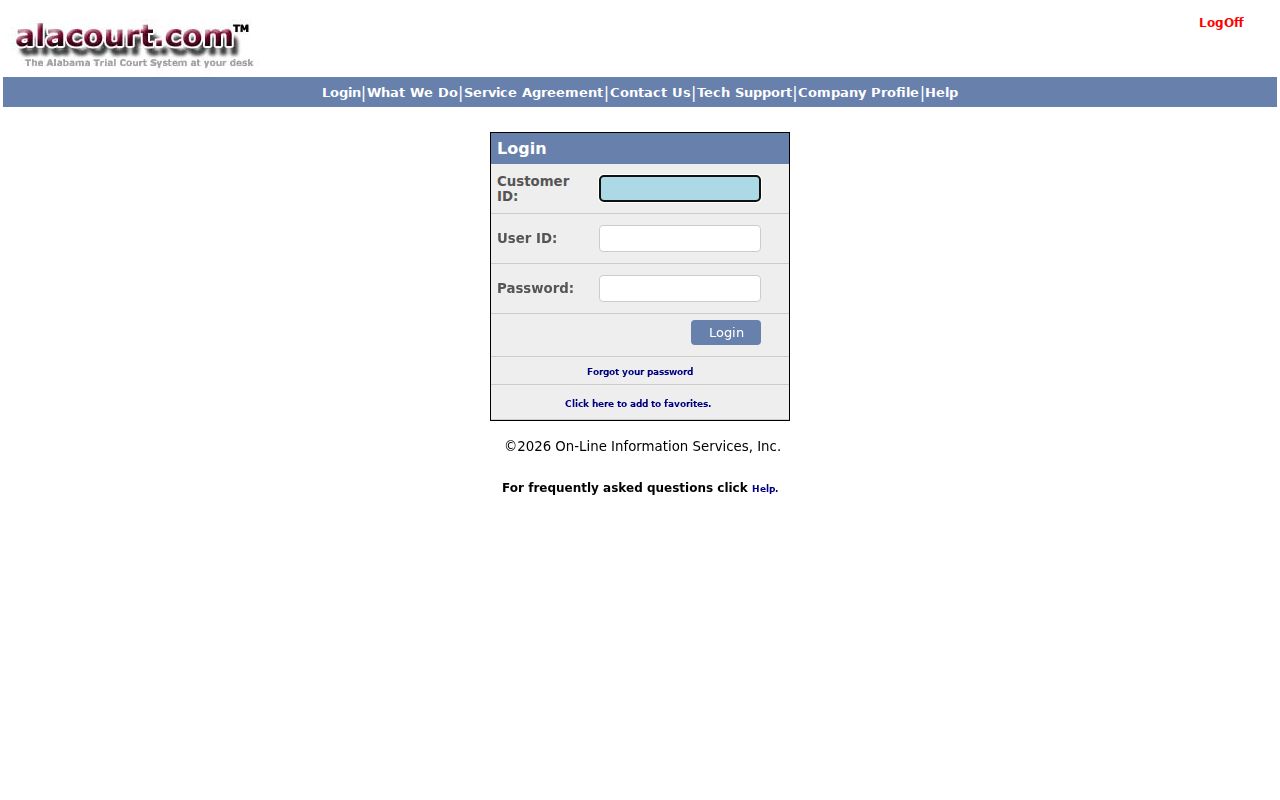
A subscription does not make a court date more authoritative. A later court order or the clerk's official file still controls the Colbert County docket.
If You Miss a Court Setting
Act at once if you miss a court setting. Call the court that owns the case and give the case number, division, missed date, and your contact details. If represented, contact counsel. Ask what the docket now records and whether a new setting or court action exists, and never assume an online blank means the matter ended.
Missed a Colbert County court date? A criminal docket may record a bond forfeiture or capias after nonappearance, while consequences depend on the case and the court's order.
Contact the correct clerk and counsel promptly, and follow the court's instructions before appearing or sending any payment.
Some docket terms describe consequences, not endings. A bond forfeiture is a docket consequence tied to an unmet appearance or bond condition. A capias is a court command to take a person into custody. Neither term is the disposition of the underlying charge. Civil consequences differ by posture. They may include court action based on a party's failure to take a required step. Only the court record and legal advice can resolve the exact result.